
Free printable egg laying log
Print one page a month and write down how many eggs you collect each day, with a note on anything that changed. Penn State Extension says hens need 14 to 16 hours of light a day for top production, so a fall slowdown usually shows up in the log first.
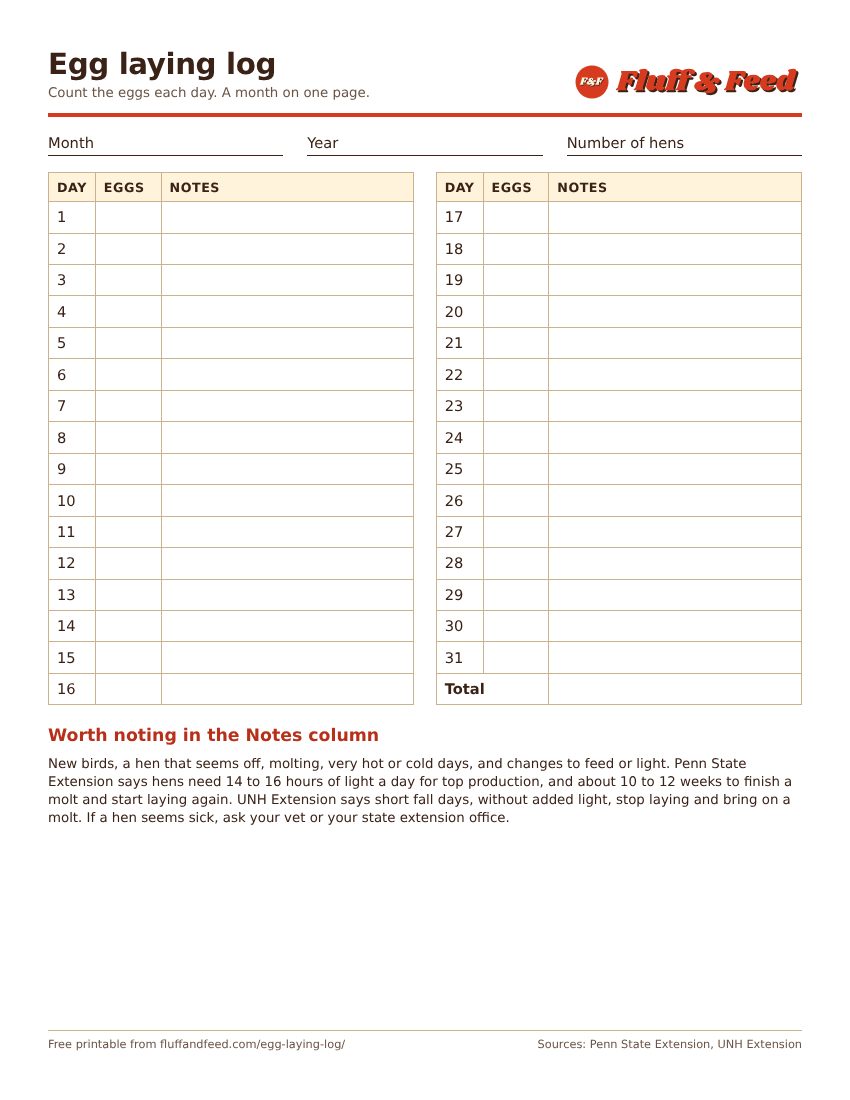
A one-page log for counting your eggs each day. Print one a month, keep it by the door, and you'll see your flock's pattern by the end of the season. It's free, with no email needed.
Download the egg laying log (PDF, 1 page)
What's on it
- Blanks for the month, year and number of hens.
- A row for each day, 1 to 31, with space for the egg count and a note.
- A total for the month.
- A short list of things worth writing down.
Why keep a count
A count shows you when laying changes, and the notes help you work out why. Light is the big one. Hens need 14 to 16 hours of light a day for top production, and you should never cut the light period on birds that are laying (1). Without added light, fall days get short enough to stop laying and bring on a molt (2).
A molt takes a while. Birds take about 10 to 12 weeks to finish a molt and start laying again (1). If your notes show a slowdown in fall, that's the likely reason. For the full list of causes, see why your chickens stopped laying.
If a hen seems sick as well as off her lay, ask your vet or your state extension office.
More free printables
- Chicken chore chart: daily, weekly and monthly jobs to tick off.
- Winter flock checklist: get the coop ready before the first hard freeze.
 More questions about tracking eggs
Is the egg laying log free?
Yes. Download the PDF and print it. You don't need to give an email address.
Why are my hens laying less in fall?
Usually light and molting. Per Penn State Extension, hens need 14 to 16 hours of light a day for top production, and a molt takes about 10 to 12 weeks before they lay again. Per UNH Extension, short fall days stop laying and bring on a molt.
How many eggs is normal?
Per UF/IFAS Extension, hens start laying at about 18 to 22 weeks old. A flock climbs to a peak of about 90% laying six to eight weeks later, then slowly drops to about 65% after a year of laying. To find your rate, divide the day's eggs by your number of hens and multiply by 100. With 6 hens, 90% is 5 or 6 eggs a day, and 65% is about 4. These figures are for a whole flock, not one hen, and breed and season change them. Per UF/IFAS, good layers lay for about 50 to 60 weeks, then rest in a molt.
Sources
- Penn State Extension: Management Requirements for Laying Flocks. 14 to 16 hours of light, never cutting light on laying birds, 10 to 12 weeks for a molt.
- UNH Extension: Producing Your Own Eggs. Short fall days stop laying and bring on a molt.
